
Ultra-black
What Musou Black actually is
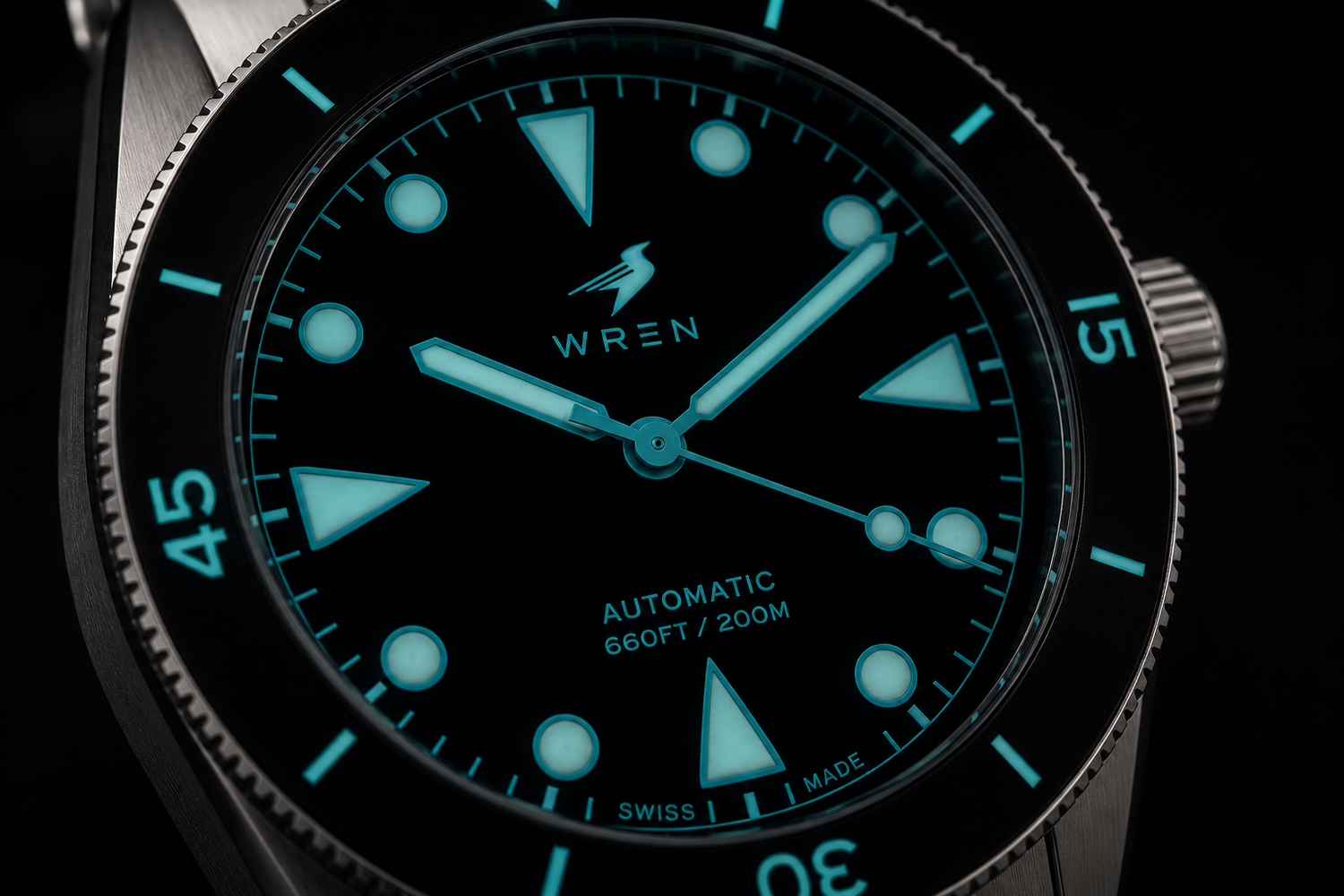
Wren uses Musou Black on the dial of the Diver One Abyss. It is not a marketing name for a very dark paint. It is a specific material with a specific number attached, and the number is the reason the dial does not look like a dial.
The number
Musou Black absorbs 99.4% of visible light. Developed by Koyo Orient Japan and released in 2020, it is a water-based acrylic — a paint, sold commercially, not a restricted laboratory process.
The figure only means something next to the alternative. A good matte black watch dial reflects somewhere between two and six percent of the light that hits it. That sounds like very little, and it is — but it is enough for your eye to locate the surface, register its curvature, and understand it as a physical thing at a particular distance.
At 0.6% reflectance there is almost nothing coming back. Your eye gets no return signal, so it cannot place the surface, and the dial stops reading as a surface at all. It reads as depth. The hands and indexes appear to float in front of nothing rather than sit on something.
How it works, roughly
Ultra-black materials do not achieve their darkness through pigment alone. There is a limit to how much light a pigment can absorb, and it is nowhere near 99%.
What gets you past that limit is geometry. The surface is structured so that light entering it is trapped rather than reflected — a ray strikes the surface, is partially absorbed, bounces deeper into the structure rather than back out, is partially absorbed again, and so on. Each bounce costs it energy. After enough bounces, effectively nothing escapes. The material is dark not because it swallows light in one pass, but because it never gives light a clean path back to your eye.
Koyo Orient does not publish the full composition, so anyone claiming to describe the exact chemistry is guessing. The principle above is common to every ultra-black material, but the specific formulation is theirs.
Musou Black and Vantablack are not the same thing
They get used interchangeably and they should not be.
| Musou Black | Vantablack | |
|---|---|---|
| Absorption | 99.4% | 99.965% |
| What it is | Water-based acrylic paint | Carbon nanotubes grown on the surface |
| How it is applied | Sprayed or brushed | Grown in a chamber at around 400°C |
| Availability | Sold commercially | Tightly restricted |
| Use in watches | Possible in series production | A handful of watches, tiny runs, five and six figures |
Vantablack is darker, and meaningfully so — 0.035% reflectance against 0.6%. But it is a structure of carbon nanotubes grown on the substrate at around 400 degrees Celsius, which places real constraints on what you can put it on and how many you can make. It has appeared in watchmaking on pieces like H. Moser & Cie’s Vantablack Venturer and Endeavour concepts, in runs of ten to a hundred, at prices that put them in a different category of object entirely.
Musou Black gives up a fraction of the darkness and gets back practicality. That trade is the entire reason an ultra-black dial can sit inside a 200m dive watch at a price a person might actually pay.
Why ultra-black dials are rare
The coating is delicate before the watch is assembled, and it cannot be polished or reworked. A conventional dial that picks up a mark during assembly can often be corrected. An ultra-black one cannot — any attempt to touch the surface destroys the structure that makes it dark, and the dial is scrapped.
That is why these dials are produced in small numbers, and it is most of the answer to “why doesn’t everyone do this.” The material is commercially available. The yield is not.
Once the watch is closed, none of this matters. Sealed behind the crystal, the dial is as protected as any other. It only becomes relevant again if the watch is opened for service — at which point, tell your watchmaker what the dial is before they start.
What it does in a photograph
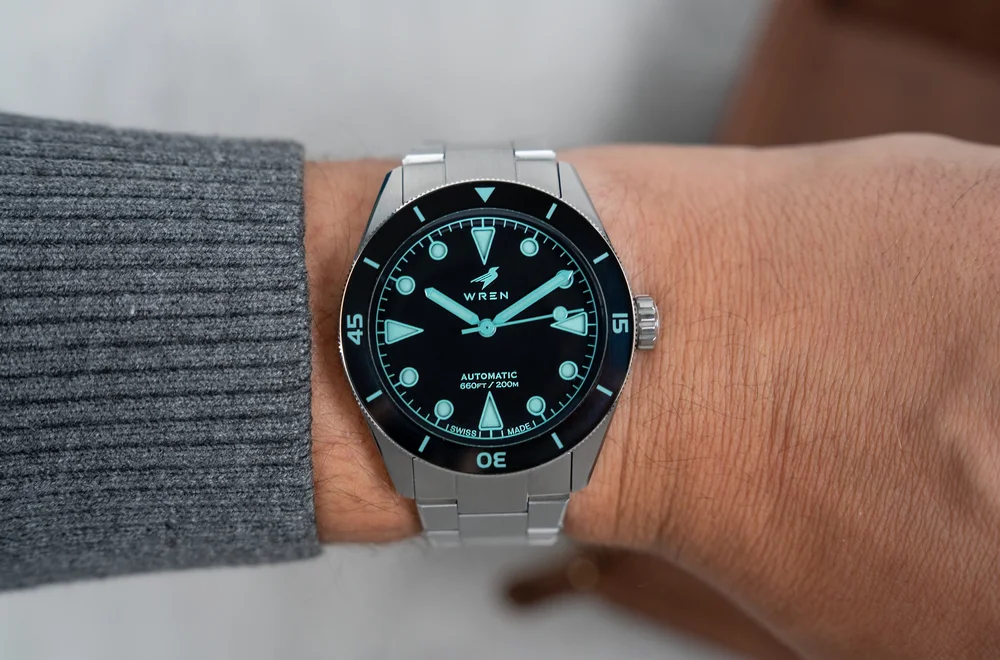
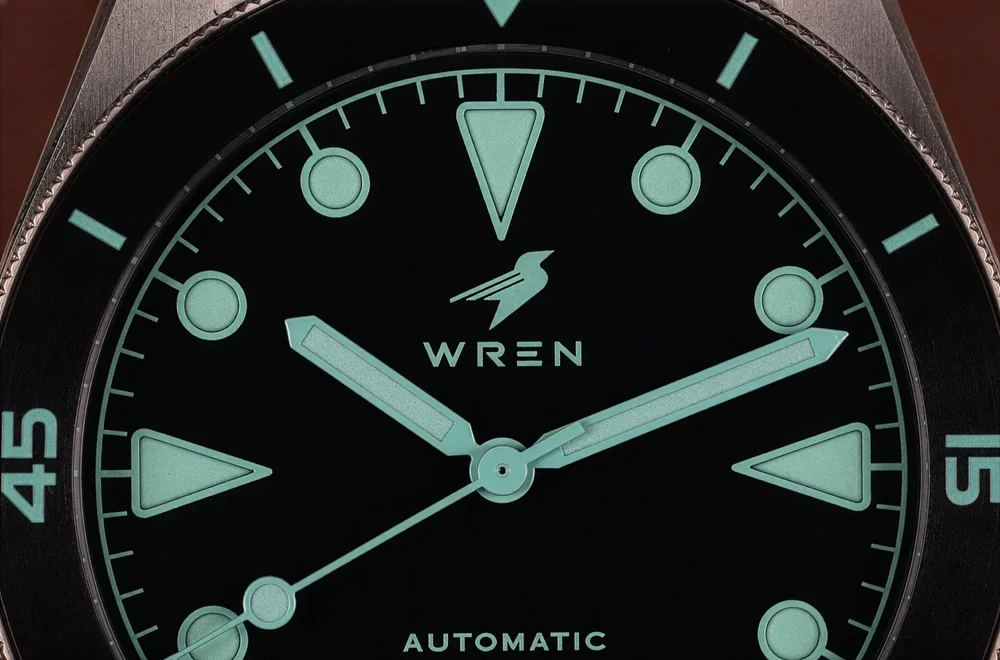
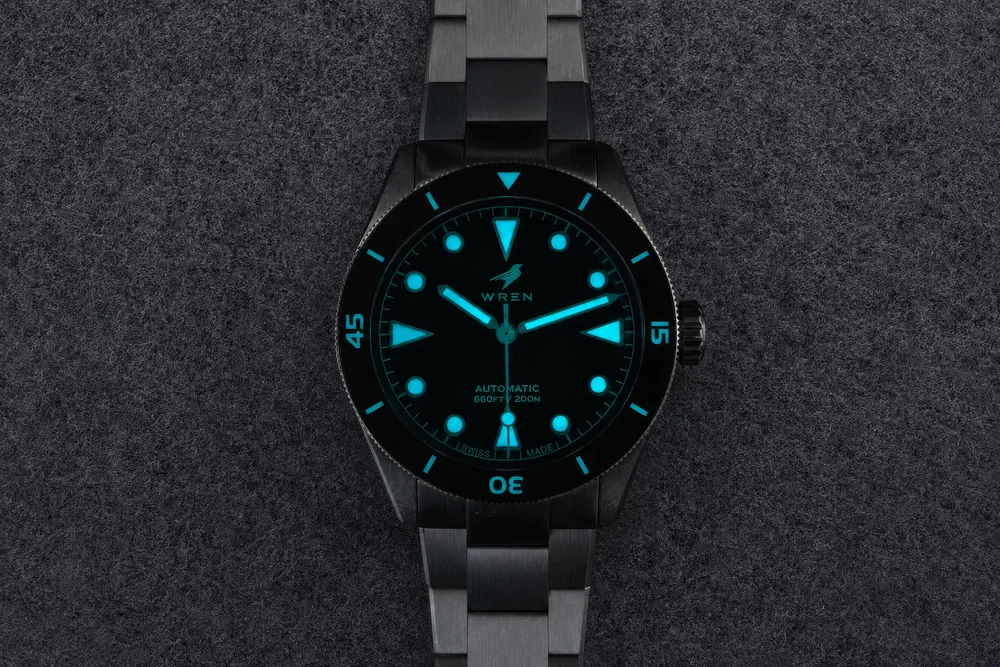
A conventional dark dial always tells you where its surface is. There is a sheen across the top of it, a curve at the edge, a faint reflection of whatever is in front of it. Musou Black returns too little light to give any of that away, so the dial reads as an opening rather than a surface, and the markers and hands appear to float with nothing behind them.
It is worth looking closely at the pictures below. Watch the light travel along the case, reach the edge of the dial, and simply stop. It does the same thing in person.
Where to see it
Musou Black is on the dial of the Diver One Abyss. The case is not black — the Abyss uses the same clear DLC as the rest of the range, so the steel still looks like steel. The black is in the dial and the ceramic bezel.
More on the material, the bezel and the lume is in the FAQ. The calibres behind the range are covered on the movements page.